La construction durable suit les réglementations cantonales
Publiée: 19 avril 2023Dernière mise à jour : 11 novembre 2026


Sujets
The war in Ukraine and its consequences have very much highlighted our dependence on fossil fuels, and that sustainability in construction is an essential component of a future-oriented energy policy.
Switzerland has varying regulations in this area across its different regions, owing to the constitutional competency of each canton. In light of this, the Conference of Cantonal Energy Directors (EnDK) has adopted the Model Cantonal Energy Regulations (MuKEn) of 2014, which aim to harmonize and thus simplify construction planning and the corresponding approval procedures as far as possible.
We have examined how close the implementation of selected cantonal sustainability regulations is according to the MuKEn. The full analysis can be downloaded here (german). The analysis shows that Basel-Stadt, Lucerne, Jura, and Fribourg base their energy legislation relatively closely on the model regulations and, in some cases, even go beyond them. At the other end of the scale are Aargau, Uri, and Zug, who are currently planning implementations, and Solothurn, which will have the fewest regulations in place in the foreseeable future.
The setting: cantonal responsibility intercantonal coordination
According to the Federal Constitution, energy policy in the building sector is the responsibility of the cantons. Therefore, they are entitled to define and implement their own energy and climate policy goals within the framework of federal law.
This allocation of responsibility makes perfect sense: Cantonal authorities are very familiar with the infrastructure, population, and sensitivities of their respective regions. They can thus plan and implement building law measures properly, efficiently, and with wide support.
However, the result is also a structure of different regimes, each with different characteristics and emphases. This can cause confusion among real estate players operating on a supraregional scale. Moreover, since economies of scale are more difficult to achieve, the federalist division of roles leads to efficiency losses.
Politicians have also understood this. For this reason, cantonal councilors and experts are developing and coordinating common energy and climate policy objectives and strategies during cantonal conferences, such as the aforementioned MoPEC 2014. Further relevant conferences are:
- Conference of Cantonal Energy Directors (EnDK)
- Energy Agency Conference (EnFK)
- Conference of Building, Planning and Environmental Directors (BPUK)
- Conference of the Heads of the Environmental Protection Offices (KVU)
Selected aspects of cantonal sustainability regulations
Currently, 21 cantons have incorporated the MuKEn into their energy legislation, and the corresponding process is underway in another four. Only the Solothurn canton has not applied much of the MuKEn 2014, due to a negative referendum decision.
The implementation of two selected provisions of the MuKEn is shown below to provide an overview of the cantonal sustainability regulations.
Requirements for boiler replacement
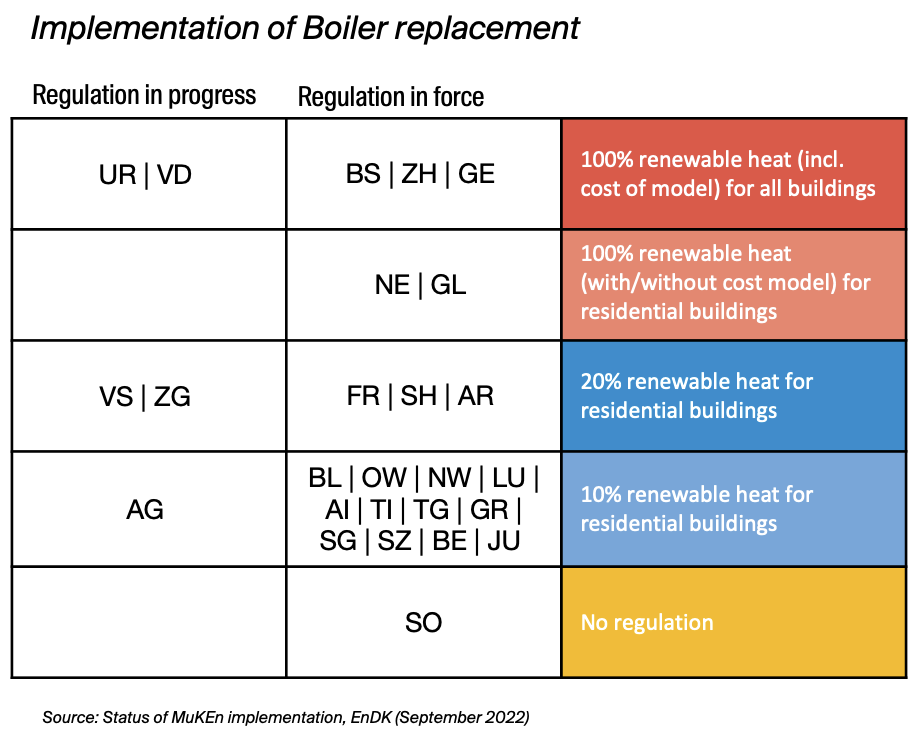
This thought has probably crossed the minds of many homeowners in recent months: Replacing an oil or gas boiler with a heating system that is not dependent on fossil fuels. In practically all cantons, the rule is that at least part of the newly generated heat must come from renewable energy sources. In Basel-Stadt, Zurich, and Geneva, this percentage is as high as 100% for all buildings. However, in the Zurich cost model, substituting these heating sources has been proven to lead to significant additional life cycle costs. In Neuchâtel and Glarus, this regulation is only applicable to residential buildings, while other cantons require 10% or 20%. In Solothurn, no corresponding regulation currently exists.
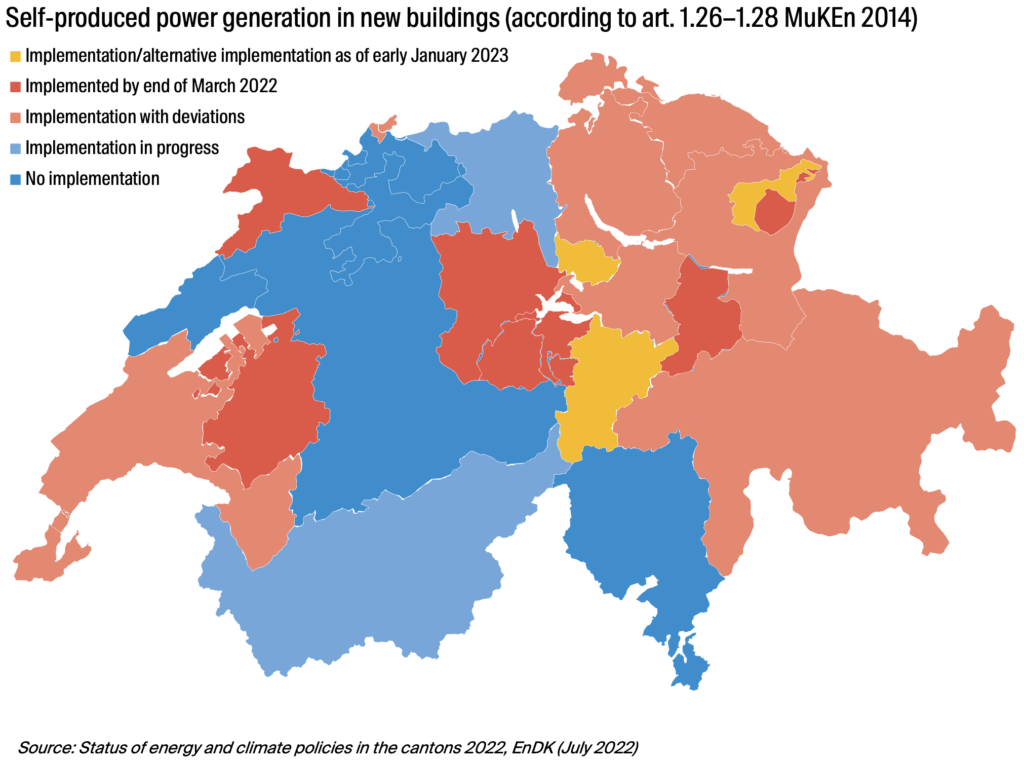
Today, new buildings can independently cover part of their electricity consumption with photovoltaic systems. With the MuKEn 2014, the cantonal energy directorate agreed on a mandatory minimum share. The requirement is a capacity of at least 10 watts per square meter of energy reference area. The entire property must produce a maximum output of 30 kilowatts, which corresponds to the electrical output of 15 ovens, 2,500 LED light bulbs, or 6,000 cell phone chargers. Alternatively, homeowners can pay a replacement fee.
Here, too, the cantonal spirit is at play: The amount is determined individually by each of the 20 cantons that have already implemented the corresponding model regulation. Since the beginning of January, due to the federal decree for urgent measures to ensure short-term power during winter last fall, cantons that have not implemented the MuKEn 2014 in accordance with the corresponding article must now also install solar systems on the building envelope for new buildings of 300 square meters or more.
This new regulation for photovoltaics shows the dynamics of the legislation. In mid-March, the National Council will debate national requirements regarding photovoltaic systems. Other developments also came into force at the beginning of 2023. For example, the new energy law of the Glarus canton, which has become legally effective on January 1, 2023, comes very close to a ban on the installation of fossil fuels.
Accordingly, there will continue to be local differences in legislation in the future, not only in the regulations but also in the support measures. For example, the amount of deductions that can be claimed against taxable income for energy measures varies by canton. In the case of subsidies, there are even municipality-specific differences. We’ll explore this further in a later blog post. Accordingly, there will continue to be local differences in legislation in the future, not only in the regulations but also in the support measures. For example, the amount of deductions that can be claimed against taxable income for energy measures varies by canton. In the case of subsidies, there are even municipality-specific differences. We’ll explore this further in a later blog post.
Learn more about regulation in the sustainability sector through this specialist course (in German): «Sustainability for Real Estate Professionals».