Potential of single-family home neighborhoods
Published: May 5, 2026Last updated: May 27, 2026




Topics
The future of single-family home neighborhoods
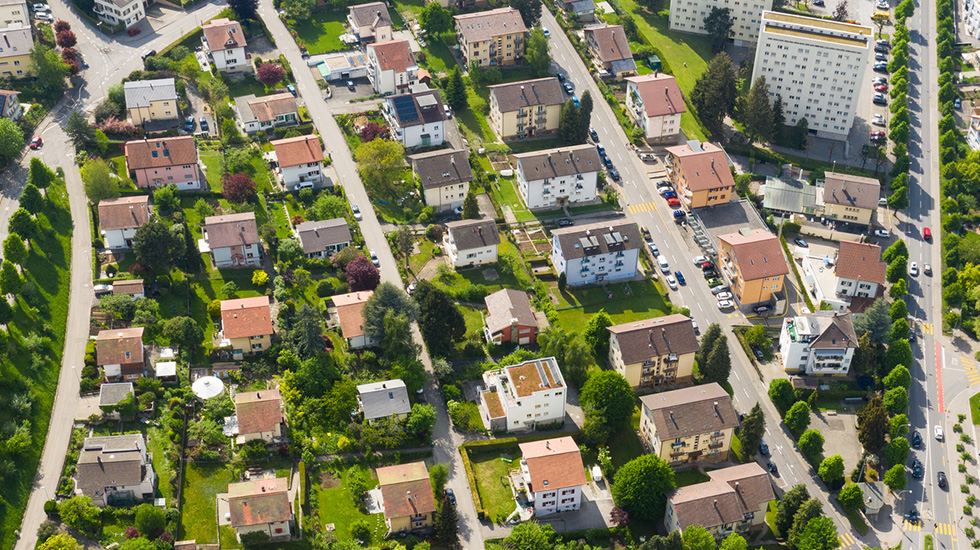
Single-family home neighborhoods characterize large parts of Switzerland’s residential landscape and are a major contributor to quality of life for many people. They stand for stability, established communities, and a familiar living environment. At the same time, many of these neighborhoods are entering a phase in which renovations are overdue and a generational change is taking place.
This creates new opportunities, especially as many areas have development reserves that remain largely underused. In view of the strained housing market and the goal of limiting urban sprawl, it is worth exploring this potential in more detail. The focus here is not on replacing what already exists, but rather on assessing how additional housing can be created without compromising the qualities that make these neighborhoods attractive.
A data-driven analysis
As owning a single-family home remains a major life goal for many people, this topic must be approached with considerable sensitivity. In order to establish an objective basis around this, Wüest Partner is currently conducting a study in collaboration with cantonal and municipal authorities, as well as the Federal Office for Housing (BWO).
The aim is to provide a clear overview: What is the current situation? Where are there realistic development opportunities? And how can these be linked to support senior housing needs or demographic change adaptation? Based on these findings, we will develop targeted approaches to create incentives for both property owners and the public sector.
Implementation and outlook
The study is just a first step. Subsequently, the work will continue together with municipalities, experts, and other stakeholders, with a focus on concrete solutions that can be implemented locally. The aim is to identify opportunities for owners who wish to further develop their properties as well as municipalities looking to strengthen their neighborhoods over the long term. The key will be to shape framework conditions in a socially responsible and sustainable way that enables development — not by restricting what already exists, but by creating new options.